Showing posts sorted by relevance for query foundation. Sort by date Show all posts

Tuesday, October 13, 2009

Modern Foundation Garments to Make Your Vintage Dresses Fit Correctly

I had a lot of requests for suggestions about where to find modern foundation garments like the vintage styles I featured yesterday. Jenifer is correct when she says that the elastic and fabrics of most vintage foundations have degraded with time and do not support as well as they once did. And Gladys is spot on when she says you can't find this type of foundation garment in most stores today. No matter what others say, Spanx is just a body smoother, not a proper foundation that controls and supports.

I've been doing some research for you this morning, and have found several modern foundation garment manufacturers that look like they will meet the needs of those of you who want to wear vintage clothing.

First, and perhaps best known, is Rago Shapewear. Rago offers many styles in various control weights from light all the way up to extra firm. In business for over 50 years, Rago produces garments with exceptional attention to shaping the female form.

Other manufacturers to look for are Custom Maid, Grenier, and Crown.

So, where can you buy modern foundation garments from these manufacturers? There are lots of online shops that offer them. I have not purchased from any of these online sites, so none of my recommendations can be considered a personal endorsement, but in doing my research this morning, these sites carry the best selections, and most have customer service numbers so you can get help with fitting and questions:

A Slip of a Girl sells lots of vintage lingerie styles on Amazon, including this open bottom girdle by Rago

Girdle Bound offers a huge selection of new foundation garments in vintage styles. They will also custom dye your piece in any color you chose for an added fee.

Secrets in Lace has been in business since 1984, and offers a wonderful selection of foundation garments in regular and plus sizes.
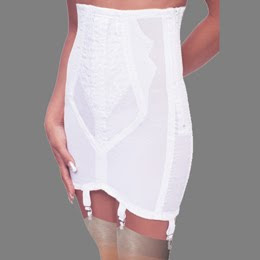
American Shapewear carries the entire Rago product line.

If you prefer to shop in person, check your local yellow pages for "Foundation Garments". Keep in mind that most lingerie stores, like Victoria's Secret or Fredericks, will not carry the type of girdles you're looking for. You want to find the store that's been around for years and years, then look for the older woman who has worked there forever. She knows what you want. You can also try your local Sears or Macys, but you'll be on your own, as most sale clerks there won't be trained in fitting you.

Best of luck in finding foundations that work for you! Please let me know how it goes!

Thursday, July 02, 2009

The Correct Foundation Garments to Wear Under Your Vintage Dresses #4

Dear readers - I am feeling rather blah with a nasty head cold. This week, I will be republishing one of my most popular series regarding the correct foundation garments to wear with vintage dresses. This series still gets hits on a weekly basis, so I thought it would be useful to publish it again.


The final post in our series on correct foundation garments ends with a focus on sleek thighs. "Study the liquid lines of the dresses - they're newest in soft, covered-up wools for day-into-party wear. The brilliant red colorings (not for the timid) and subtly revealing cut (nice for the shapely) demand the firmest sort of discipline for hips and thighs. Pretties to aid and abet: long-legged panty girdles to comfortably coax and wheedle you into the willowy-wand shape that's needed."

The dress on the left has a flounce skirt in a printed wool/orlon jersey. The dress, by California Girl, sold for $30 (about $228 today) was sold at Hahne & Co., Newark, and Haggarty's, Los Angeles. Her long necklace is by D'Arlan.

Under this dress, the model is wearing a Youthcraft panty girdle with red stripes on white and a Madenform cotton bra.

The solid red dress on the right by Jonathan Logan is in wool crepe. This dress sold for $15 (about $115 today) and was available at Lord & Taylor, May Co., and The Broadway. She wears a Coro necklace.

Under this dress, the model is wearing a Jantzen panty girdle of nylon and Lastex with a Jantzen cotton bra.

I hope you've enjoyed this series of articles. Remember, these photos all came from Seventeen magazine - so proper foundation garments were expected to be worn by young girls, not just grown women. Can you imagine wearing a girdle to high school?

Monday, June 29, 2009

The Correct Foundation Garments to Wear Under Your Vintage Dresses #1

Dear readers - I am feeling rather blah with a nasty head cold. This week, I will be republishing one of my most popular series regarding the correct foundation garments to wear with vintage dresses. This series still gets hits on a weekly basis, so I thought it would be useful to publish it again.


If you've ever purchased a vintage dress and wondered why it doesn't fit correctly, maybe you're not wearing the proper foundation garments. Prior to the late 1960's, clothing was styled and cut with the understanding that women would be wearing girdles and shapers underneath. In the October 1958 Seventeen magazine, there is a wonderful editorial spread photographed by Francesco Scavullo that illustrates what type of foundation garments work best with several dress styles. I'll be featuring the photos and information from this spread this week.

The magazine is referring to these as "shaft dresses" (never heard that term before). "Newest shape for a shaft to take - the high-rise Empire waist, which looks prettiest over a softly rounded bosom, asks just supple control from there down."

The red dress is by Lanz in a lined rayon crepe. See that band across the bust? The magazine calls this a "bosom yoke" and it drops to a V-neck with a bow in the back. The dress sold for $40 in 1958 (about $298 today). The model is wearing red DeLiso Debs shoes.

Under the red dress, the model is wearing a Formfit nylon bra with circle-stitched lace cups and a Formfit nylon elastic net panty girdle with a wide waistband and satin elastic vertical stretch panels front and back.

The model on the right in the top photo is wearing a blue wool jersey "shaft dress" by Jerry Greenwald. The front is gathered into a satin band at the Empire waist. In back, the dress is slit from V neckline to hem, revealing a satin underslip. This dress also sold for about $40 and was available at Saks Fifth Avenue. That's a long, skinny brooch by Castlecliff pinned to the center of the satin band and the shoes are by Capezio.

Under the blue dress, the model is wearing a Lovable "lightweight all-in-one for a long, slim line with easy control." Made of Helance nylon yarn with embroidered cotton broadcloth cups. This appears to be an open-bottom style.

Thursday, August 21, 2008

The Correct Foundation Garments for 1950s Dresses #4


The final post in our series on correct foundation garments ends with a focus on sleek thighs. "Study the liquid lines of the dresses - they're newest in soft, covered-up wools for day-into-party wear. The brilliant red colorings (not for the timid) and subtly revealing cut (nice for the shapely) demand the firmest sort of discipline for hips and thighs. Pretties to aid and abet: long-legged panty girdles to comfortably coax and wheedle you into the willowy-wand shape that's needed."

The dress on the left has a flounce skirt in a printed wool/orlon jersey. The dress, by California Girl, sold for $30 (about $228 today) was sold at Hahne & Co., Newark, and Haggarty's, Los Angeles. Her long necklace is by D'Arlan.

Under this dress, the model is wearing a Youthcraft panty girdle with red stripes on white and a Madenform cotton bra.

The solid red dress on the right by Jonathan Logan is in wool crepe. This dress sold for $15 (about $115 today) and was available at Lord & Taylor, May Co., and The Broadway. She wears a Coro necklace.

Under this dress, the model is wearing a Jantzen panty girdle of nylon and Lastex with a Jantzen cotton bra.

I hope you've enjoyed this series of articles. Remember, these photos all came from Seventeen magazine - so proper foundation garments were expected to be worn by young girls, not just grown women. Can you imagine wearing a girdle to high school?

Tuesday, March 01, 2011

Why Can't I Find a 50s Dress That Will Fit Me?

James Galanos, 1955

That's the#1 question I get in my inbox. Other versions are, "Why are the waist sizes on all your 50s dresses so tiny?" or "My measurements are 36-30-37 (or 42-37-44, or 39-33-38). Do you have a 50s dress that will fit me?" In fact, I get this question so often, I am going to address it here for all of you who have been frustrated in your search for an authentic vintage dress.

The fact of the matter is, the industry standard for measurements in the 1950s was a 10" difference between the bust and waist. That means if you find a dress with a 36" bust measurement, 9 times out of 10, that dress will have a waist that measures 26". If you don't have a waist that is 10" smaller than your bust (and believe me, most of us modern women don't), that explains why you're having a difficult time in your search.

So what's a gal to do? Here are some suggestions to help you overcome the obstacles.

#1 - Consider foundation garments.

Yes, a girdle. In the 1950s, every woman wore one nearly every day starting in her teens. If you'd been wearing a girdle from the age of 15 or so, you'd likely have a tiny waist too, as it would have been trained into shape! I've talked about the importance of wearing foundation garments with your vintage dresses before. If your waist is only 1"-2" larger than what it needs to be to fit into that dress, wearing a strong girdle or waist cincher may be just what you need to get that dress to fit. I'm not talking about Spanx or shapewear. They just won't give enough support. Here are some suggestions for finding the correct modern foundation garment for you.

#2 - Consider separates.

If you can't find a dress that will work, consider separates. Look for a vintage skirt that will fit your waist and pair it with a blouse, a knit top, or a jacket that fits your bust. Voila!

#3 - Consider a dress from the 60s instead.

Pierre Cardin, 1966

By the mid-to-late 60s, women were moving away from wearing a girdle at all times, and styles moved to a more relaxed waistline. If there is a 6" or less difference between your bust and waist measurements, your body type may be more suited to a shift or empire waisted style from the 1960s. Try it!

#4 - Have a dress altered to fit you.

Many vintage dresses were made with the understanding that the new owner would have the garment altered for a custom fit. As such, they are often made with sufficient seam allowances to let a dress out at the waist by 1"-2" or more. You can also consider letting out the back darts in the bodice to gain more room, although this sometimes leaves visible needle marks in the fabric. A talented seamstress can add narrow panels into the side seams to let out the waist even more. While an alteration like this is not invisible, it is a workable option if you need to let out a dress more than 3". Before buying, ask the seller how deep the seam allowances are or if there is sufficient fabric in the hem to cut narrow bands for those extra panels.

#5 - Sew your own or have a dress custom made.


Most of the major pattern companies now offer modern reissues of vintage styles. And vintage patterns abound on the web. If you can sew and know how to alter a pattern to fit, making your own dress is a great option. If you are going to use a vintage pattern, you'll likely have to know how to grade the pattern up or down to fit your size. If you can't sew, find a good custom dressmaker in your area to do the job for you.

I hope these suggestions help you in your search! If you have another to add, please post it in the comments!

Wednesday, June 04, 2014

What's Under That Vintage Dress? Part 2

Monday's post about foundation garments got a lot of interest with comments, emails and even a phone call!  Here are a couple more examples today.

The strapless cocktail dress by Ceil Chapman shown above is worn over a strapless supportive bra and an open bottom girdle by Perma-lift. If you can't get the look without bulges between the two pieces, then wear an all-in-one corset.

And lest you think that girdles were only worn for evening, think again, my friends.  Women wore girdles with their daytime dresses too.  The Sportwhirl sheath shown here is worn with a supportive bra and panty girdle, both by Perma-lift.

I know what you're thinking.  "They don't make foundation garments like this anymore!"   WRONG!  There are several companies that do, including Secrets in Lace, as shown here.  Back in 2009, I did a long blog post about modern foundation garments to wear under your vintage clothing.  It includes tips and links to several companies that offer the types of corsetry you need.  Be sure to read the comments, as many readers shared other companies to look for too!


Thursday, November 11, 2010

DIY 1955 Party Make-up

Here are step-by-step instructions on how to get this Far Eastern influenced holiday party look from December of 1955. Use one or more of these steps to change your appearance, or if you're quite adventurous, go for some serious glamour by following all of them. To see the look in more detail, click on the picture for a larger view. I must make note that many of these ideas are quite extreme and not at all practical by today's standards. Still, it is fun to get a glimpse into high fashion make-up artistry from the past.

1. Pluck away your entire eyebrow from the highest point of the arch out to the outer corner.
2. Cover the entire face and neck with a pale shade of foundation. There should be no pink tint.
3. Cover the eyelids up to the brows with pure white foundation or cream eye shadow. Blend carefully to accentuate the uptilt of the brows.
4. Pencil in the eyebrows with a very dark eyebrow pencil. Note the line of the penciled brow is higher and wider than the natural brow.
5. Outline the upper and lower lashes with dark eyeliner starting at a point near the bridge of the nose and extending both strokes out and away at the outer corners of the eyes.
6. Fill in the tiny triangle at the outer corners of the eyes with the white cream eye shadow.
7. Powder over the foundation with a pale ivory or beige. There should be no pink tint. No rouge or blush is used.
8. Outline the lips. The upper lip is drawn smaller and very thin. The lower lip is fuller. Fill in with bold red lipstick.

Wear your hair combed back straight and tight to the head. Add a black wig, if desired.

Tuesday, June 30, 2009

The Correct Foundation Garments to Wear Under Your Vintage Dresses #2

Dear readers - I am feeling rather blah with a nasty head cold. This week, I will be republishing one of my most popular series regarding the correct foundation garments to wear with vintage dresses. This series still gets hits on a weekly basis, so I thought it would be useful to publish it again.


Continuing the series on the correct foundation garments, today we have two party dresses from 1958. The focus on today's spread is the tiny waist needed with fuller skirts. "Take a look at the luscious, jewel-toned dresses. See how their sculptured bodices and dome-shaped skirts show off your middle? They call, obviously, for a trim mid-section of your own."

The green satin dress on the left is a "princess sculptured" dress with self-fabric roses at the neckline and hem by Parklane, which was offered at Franklin Simon, New York and Jordan Marsh, Boston. The dress sold for about $30 in 1958 ($225 today).

Under the green dress, the model is wearing a Formaid of Boston torso bra that molds from bosom to hips. With that, she wears a Saramac petticoat. Note that the petticoat has a flat panel from waist to hips and the long-line bra is worn over it.

The blue jacquard dress on the right has a "closely carved bodice and dome skirt that opens in a back pleat". This dress is by Carol Rodgers and sold for about $13 in 1958 ($97 today). The skirt of this dress likely has the stiff Pellon interfacing, as the model is not wearing a crinoline under it.

Under the blue dress, the model is wearing a Sarong Two nylon girdle that trims the waist with a high elastic waistband. Crisscross front with open bottom gives walking ease. Power net sides and satin elastic back. She is also wearing a Perma-lift strapless cotton contour bra.

Monday, May 23, 2011

Frances Sider - Swimsuit and Play Clothes Designer

Frances Sider, 1957.
 Frances Sider was an American designer of swimsuits, play clothes and sportswear in the 40s and 50s.  I had honestly never heard of her until I came across an image of one of her swimsuits in my archives.  Of course my curiosity was piqued and I had to find out more.  Unfortunately, there is not much known about Sider today, but here is what I did find out.

1946
 Sider started her business about 1938 in New York designing swimsuits and beach wear.

1946
 She was designing two piece swimsuits earlier than most as you can see by these first two images from 1946.

1948
 She also designed play clothes, sportswear and casual separates.  All of Sider's swimsuits and strapless dresses were constructed with inner foundations for support and slimming.


1949
 Most of her swimsuits were available with matching separates so a woman could go from the pool to the town with ease and comfort.  The swimsuit above was available with a separate wrap skirt that turned it into a sarong style dress.

1950
This dress could be made strapless by removing the halter style strap.

1950
 In 1950, Frances Sider became the first designer to be granted a patent regarding the construction of a swimsuit for the inner foundation she designed to go in her swimsuits.  It was attached to the front of the suit only and the panty was separate from the bra at the back for ease of movement.  She called this inner foundation the "Sun Body" and it came in all her suits.  She started designing separate foundation garments in 1951 and was granted two more patents, one for a long line corset and one for a strapless bra.

1951
By the early 1950s, Sider was also designing loungewear and dressier separates.  In 1954, Sider decided to leave her career and closed her business.  At the time, she said she wanted to be at home with her husband and daughter and regretted the years she had missed watching her daughter grow up.  She moved to Florida to be near her daughter sometime before 1957.

1951
In 1957, Sider once again began designing swimsuits and sportswear, this time based in Miami, but her newly launched line was never as successful as it had been in the past and she disappears from media mention by 1958.

Please note: This biography about Francis Sider is copyright of Couture Allure and may not be copied without permission.

Monday, October 12, 2009

Foundation Garments to Make Your Vintage Dresses Fit Correctly

Buyers of vintage clothing often wonder why these garments don't fit as well as they would like. The answer? Foundation garments! Prior to the late 1960s, every woman had a complete wardrobe of various foundations, because her figure was as much a part of the fashion as her dress. In fact, vintage garments were designed and constructed with the understanding that the woman who wore them would be wearing the correct bra, girdle, and slip.

Here are four looks from 1950, with the foundation garments that should be worn underneath for precise control where the style required it.

1950 Simplicity Designer Pattern 8207

Essential for the long fitted jacket and straight skirt is firm derriere control. Flexees girdle with Lastique net over hips and small of back to give suport and suppleness, while a satin lastique panel flattens the derriere. Maiden Form brassiere.

1950 Simplicity Designer Pattern 8252

A sheath dress calls for extra attention to the waistline and thigh. Jantzen girdle has a high waistline to control the diaphragm, while the long length controls the thighs and hips. Maiden Form strapless brassiere for the low cut neckline.

1950 Simplicity Designer Pattern 8224

The sculptured line of a slim basic dress requires the smooth control of an all-in-one corset. This Warner Bros. boneless style has a separate lastex section for diaphragm control and special abdomen, derriere and hip sections with an attached bra.

1950 Simplicity Pattern 2722

The smooth front and flared back of this dress demand the firm abdomen control and fluid movement given by a Playtex all Lastex girdle. Perma-lift low cut brassiere for a deep neckline.

Monday, August 18, 2008

The Correct Foundation Garments for 1950s Dresses #1


If you've ever purchased a vintage dress and wondered why it doesn't fit correctly, maybe you're not wearing the proper foundation garments. Prior to the late 1960's, clothing was styled and cut with the understanding that women would be wearing girdles and shapers underneath. In the October 1958 Seventeen magazine, there is a wonderful editorial spread photographed by Frencesco Scavullo that illustrates what type of foundation garments work best with several dress styles. I'll be featuring the photos and information from this spread this week.

The magazine is referring to these as "shaft dresses" (never heard that term before). "Newest shape for a shaft to take - the high-rise Empire waist, which looks prettiest over a softly rounded bosom, asks just supple control from there down."

The red dress is by Lanz in a lined rayon crepe. See that band across the bust? The magazine calls this a "bosom yoke" and it drops to a V-neck with a bow in the back. The dress was about $40 (about $298 today), and was sold at Bonwit Teller, New York, Vandervoort's, St. Louis, and The Crescent, Spokane. The model is wearing red DeLiso Debs shoes.

Under the red dress, the model is wearing a Formfit nylon bra with circle-stitched lace cups and a Formfit nylon elastic net panty girdle with a wide waistband and satin elastic vertical stretch panels front and back.

The model on the right in the top photo is wearing a blue wool jersey "shaft dress" by Jerry Greenwald. The front is gathered into a satin band at the Empire waist. In back, the dress is slit from V necline to hem, revealing a satin underslip. This dress also sold for about $40 and was available at Saks Fifth Avenue. That's a long, skinny brooch by Castlecliff pinned to the center of the satin band and the shoes are by Capezio.

Under the blue dress, the model is wearing a Lovable "lightweight all-in-one for a long, slim line with easy control." Made of Helance nylon yarn with embroidered cotton broadcloth cups. This appears to be an open-bottom style.

Wednesday, July 01, 2009

The Correct Foundation Garments to Wear Under Your Vintage Dresses #3

Dear readers - I am feeling rather blah with a nasty head cold. This week, I will be republishing one of my most popular series regarding the correct foundation garments to wear with vintage dresses. This series still gets hits on a weekly basis, so I thought it would be useful to publish it again.


Today's focus is on smooth hips required when wearing a dress with a lowered waist. "Shimmy bodices that drop their waists down to hip-level...or lower, then meet rippling, flounced skirts. The silhouette-makers needed: hip-firming girdles, rounded bras."

The dress on the left has a gathered flared skirt below a dropped waist. It is by Youth Fair and sold for $15 in 1958 (about $112 today). The model wears a Castlecliff pin on her collar.

Under this dress, she is wearing a Hollywood Vassarette open bottom girdle with double panels of power net at the back and sides and a front V-shaped panel of nylon satin overlaid with point d'esprit lace. The Hollywood Vassarette bra is in nylon with lace cups.

The dress on the right, by Teena Paige, has a dropped waist, permanent pleated skirt and a sailor collar. It sold for $18 in 1958 (about $135 today) and was available at Altman's, New York and Macy's, San Francisco. The model wears a Castlecliff pin on the collar.

Under this dress, the model is wearing a Peter Pan panty girdle of nylon power net woven in elastic stripes. The Peter Pan cotton bra has contour cups.

Wednesday, June 16, 2010

How to Find the Vintage 1950s Wedding Dress of Your Dreams

Are you frustrated because you can't find the 1950s wedding dress you've been dreaming of? You're looking for a cocktail or ballerina length full skirted dress and all you're finding are full length gowns? You want strapless and everything has sleeves? That's because dresses like this Jacques Griffe from 1955 were not the norm.

You're more likely to find full skirted tulle dresses in full length.

And you're even more likely to find a dress like this that is far more simple and covered up. In the 1950s, brides were expected to look virginal and modest and churches often required brides to wear a dress with sleeves.

So, how does a bride-to-be find the 1950s style wedding dress she's been dreaming of? Here are some ideas to get you started.

1. Stop looking at wedding dresses! What you're really looking for is a 1950s evening gown, cocktail, party, or prom dress that happens to be white or ivory. A party dress is far more likely to have the design details you want, like a strapless bodice, or a full skirt that is shorter than floor length. Use search terms like "1950s white prom dress" or "vintage white evening gown" or "1950s white full skirt dress". By widening your search beyond just wedding dresses, you're far more likely to find a dress that will work for you.

2. Consider a 1950s daytime dress in white or ivory cotton, and add details like rhinestones, lace appliques, or beading to it. A wide satin sash and a bridal tiara would go a long way to making this dress work for a wedding.

3. Consider color. There are lots of 1950s prom dresses and evening gowns in pastel colors like pale pink, soft peach, ice blue, light lilac, or dove gray that would work for a wedding. Do you really have to have white? The red roses could be removed from this pale pink lace gown and it would make a beautiful wedding dress.

4. It's best to leave a vintage evening gown at it's original length. If you're considering buying a gown and having it cut off and shortened, however, be sure to consult with your seamstress before buying to make sure that the design can be shortened. A gown like this would probably look fine if shortened, but the one in the second photo above would look odd if it were to be cut off. (By the way, I never advocate altering a dress by cutting it off, but if you're thinking of doing it, make sure it will work before taking scissors to the dress. And, please, don't tell me about it!)

5. Remember you WILL need to wear a proper foundation garment under your dress. 1950s dresses were designed to be worn with a corset or girdle, and you'll probably need a full, long line corselette, like the one shown here. Need tips on how to find a modern foundation that will work? Check out this post from last year. Keep in mind that the standard difference between the bust and waist measurements of a 1950s dress is 10". For a modern gal, a dress that fits you in the bust is likely to be too small in the waist without a proper corset. Even so, you may need to alter the waistline in order to make it bigger. Be sure to ask your seller if there is room in the seams to do this. It is far easier to alter the waist than the bust.

Here's a great example of what I'm talking about. This is a 1950s strapless prom dress I just listed at Couture Allure that would make a great wedding dress. The white chiffon is lined with a pale lilac-blue taffeta for just a hint of color and the waistband is the same lilac-blue. This was not designed to be a wedding dress, but is perfect for the modern bride who wants a vintage wedding.