Two-tone coat by Paul Poiret, c. 1925. A garment by Paul Poiret is my all-time vintage Holy Grail. I would faint if I ever found this coat.
Photo by Lipnitzki-Viollet from the book "Poiret" by Yvonne Deslandres
 Two-tone coat by Paul Poiret, c. 1925. A garment by Paul Poiret is my all-time vintage Holy Grail. I would faint if I ever found this coat.

 At left, white lace dress with black silk bow at waist. Sold in 1961 for $100 (about $735 in today's dollar). Hat by Halston of Bergdorf Goodman (yes that Halston).
 At left, strapless black re-embroidered lace with white silk organza and vibrant pink silk two-piece waistband. Sold in 1961 for $185 (about $1360 in today's dollar). Hat by Vincent Harmik. Earrings by Miriam Haskell.
 At left, flare-skirted white cotton printed with pink roses and a linen inset waistband. Sold for $70 in 1961 (about $515 in today's dollar).
 At left, black linen sheath with a basket-weave neckline. Sold for $90 in 1961 (about $661 in today's dollar).
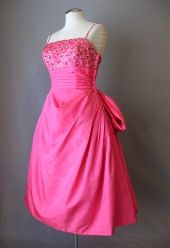
 At left, pink silk bodice with softly flared white silk chiffon skirt. Sold for $125 in 1961 (about $928 in today's dollar).
 At the Paseo de la Reforma, the model wears Estevez' belted butterfly tunic dress in white lace. Sold for $125.00 in 1960 (about $928.00 in today's dollar).
 At the Castillo de Chapultepec in Mexico City, the model wears a full skirted dress with a molded bodice in black silk satin-faced organza with embroidery and scalloped edges. Sold for $110.00 in 1960 (about $809.00 in today's dollar).
 On the steps of the Basilica de Guadalupe, Estevez black silk chiffon dress with draped hip sash. Sold for $90.00 in 1960 (about $668.00 in today's dollar).
 At the National University of Mexico, a black Taj silk cocktail sheath with a side-slashed neckline. Sold for $65.00 in 1960 (about $478.00 in today's dollar). This is my favorite of all the dresses shown over the past two days. Luis Estevez was a genius at designing unusual necklines. In fact, he became known as the "Neckline King" in the trade.
 Two models climb the pyramids of San Juan Teotihuacan.
 Cotton windowpane check is used for these two dresses, photographed at Acapulco's Gold Coast Beach. Note how the necklines are cut to follow the pattern of the fabric.
 In Colonial Guanajuato, a Spanish silver mining town, the model wears a silk dress with giant black polka dots. A wide black patent belt narrows the waist under the floating topper. Sold for $70.00 in 1960 (about $515.00 in today's dollar).
 At the cathedral of Guanajuato, the model wears a cotton zebra striped ensemble. The dress has a solid black bodice with cap sleeves. The jacket floats away from the fitted dress. Sold for $110.00 in 1960 (about $809.00 in today's dollar).
 At the diving cliffs of Acapulco, a black and white silk sheath with Kabuki sleeves and a set-in belt. Sold for $65.00 in 1960 (about $478.00 in today's dollar).
 Wear a dress cut from big squares of fabric and add horizontal stripes across your hips!
 Wear a waist length chunky knit sweater and add puff sleeves for even more width!
 Take a big bold print with horizontal stripes and zig-zags, add pleats and huge shoulder pads!
 Wear a pastel skirt with lots of pleats and three times as much fabric as you need. Add a sweater vest that blousons at the waist!
 Wear a big, bold plaid with gathers at your hips. Add an oversized sailor collar and a bow for that cutesy, innocent look!
 Wear colored ankle socks with white shoes. Add a sweater vest that two of you could fit into.

 Valentino white and orange striped cotton coat with white cotton pants from the Spring-Summer, 1967 Couture collection. Hat by Mirella Petteni.
 Funny Girl brand stripe maillot
 Ariel brand nylon/lycra with a shiny finish
 Armonia, Italy strapless maillot with feather print.
 Jean-Remy Daumas neon pink with halter strap.
 DeWeese Designs flower petal bikini and cover-up.
 Arena stripe with criss-cross straps in back.
 Norma Kamali OMO two piece with a strapless 8-gore bustier top and high cut bottom.
 A couple of months ago, I was honored to sell this gorgeous vintage 1960s evening gown to British actress Jessica Fox. The hem of the gown has godet inserts all the way around so it flares out mermaid style.
 Jessica plays Nancy Hayton on the British soap opera "Hollyoaks", and she wore the gown to the British Soap Opera Awards this past Sunday!
 Jessica, you look gorgeous, and that low back is perfect on you!
 You've met Alexis before. She wore this 1950s Anne Fogarty velvet dress purchased from Couture Allure to her Winter Ball last year.
 Alexis also purchased this stunning 1940s Patullo evening gown in navy blue with a lighter blue insert and flowers at the waist.
 Here is Alexis wearing the Patullo gown for her prom in April. She did a wonderful job of pulling an entire outfit together with a white ostrich plume in her hair and white lace gloves. Her hair and makeup are perfect accents to this glamorous look. Alexis, you're beautiful!
 Giuliana Coen Camerino has died at age 90. Founder and designer of Roberta di Camerino, she died at home on Monday night.
 Camerino began her career in Switzerland, where she had fled to escape Nazi persecution. She crafted handmade handbags, and named her company after the movie "Roberta", which starred Fred Astaire and Ginger Rogers. Returning to Venice after the war, Camerino started using Venetian craftsmen to construct the distinctive brass hardware for her bags.
 While using the finest of Italian leathers, many Roberta di Camerino bags were also made of velvet that was woven on antique looms.
 During the 1950s, Camerino began a line of clothing, and she took part in the first shows of Italian fashion at Palazzo Pitti. However, in the 1960s, her work with trompe l'oeil effects on jersey knits was what brought her great success with clothing.
 Camerino devised this method of trompe l'oeil in order to produce simply cut garments that were quick to manufacture and easy to wear, while capturing the attention with an eye to irony.
 The dresses were made from flat pieces of fabric onto which the colors were printed separately, allowing time for each to dry before applying the next.
 1. Kenzo, designer of Jap, 2. Sonia Rykiel, and 3. Yves Saint Laurent for Rive Gauche.
 4. Karl Lagerfeld (!) designer of Chloé, 5. Marc Bohan, designer of Christian Dior, and 6. Jacqueline Jacobson, designer of Dorthée Bis.
 7. Emmanuelle Khanh, and 8. Emanuel Ungaro.


 Now that you've made your guesses, tell me what is the common denominator? Why these 8? Fashion history fascinates me, and I hope you're intrigued. Answers tomorrow!




 Posts
All Comments