Livia Firth, co-founder of
Eco Age, a retailer of green and sustainable products, issued her "Green Carpet Challenge" a couple of years ago in which she pledged to only wear eco-friendly, sustainable, and green fashion on the red carpet as she accompanied her husband Colin during awards season. I applaud Livia's goal, and many of the dresses she has worn in the past meet the challenge admirably.

At the 2011 Golden Globes, Livia wore a gown made of sustainable Ahimsa silk (peace silk) designed by Jeff Garner of Prophetik.

At the 2010 Oscars, Livia wore a gown by Orsela de Castro of From Somewhere, who uses the scraps from other clothing factories to make her creations.

For this year's Oscars, Livia hired designer Gary Harvey to make her gown. Mr. Harvey has become well known for his designs using up-cycled used clothing. According to
Livia's blog at Vogue.uk, Harvey "scoured Southeast London for the right pieces, from Cancer Research shops to vintage boutiques, such as 360 Degrees Vintage." The goal was to use clothing from the 30s to honor the era in which the film "The King's Speech" was set. Colin Firth was nominated for an Oscar for his role in that film.

Pursuant to that goal, Harvey cut up 11 vintage evening gowns from the 1930s and patchworked them into the 1 dress worn by Livia for the 2011 Oscars. But can we truly consider this "green" or "sustainable"?

Many vintage fashion lovers, myself included, wondered about the condition of those 11 gowns from the 1930s. Lynn Burgess, the owner of 360 Degrees Vintage, declared on her Facebook fan page that, "He bought the very best gowns". We can possibly presume that since she owns a well known and highly respected vintage clothing store in London, the dresses must have been in at least wearable condition. She later stated, "
I did say he bought the best gowns. I didn't say they were perfect most vintage garments will have some sign of wear and tear." Yesterday, on the
Ecorazzi blog, she stated, "“Although the dresses Gary picked were beautiful they were far from perfect. There was some damage to the netting and the top part of the dress which he removed. The other dresses had some signs of wear and staining which he managed to cut out and reconstruct to make Livia’s stunning dress.”
To be fair to all parties involved, I contacted Gary Harvey and Livia Firth with this question: "Were the gowns that you used in wearable condition as they were or would they have been considered damaged beyond repair?"
Mr Harvey responded to me this morning with this statement (italics by me): "This is an unjust criticism, I am a designer with a conscious rather than destroying collectable clothing, I am preserving it for future generations.
Firstly, I have the utmost respect for vintage clothing, an avid collector for the last 20 years, I have scoured the vintage stores and markets across Europe, The USA and Japan, and as Creative Director for Levi’s I was responsible for the design of the ‘LEVIS Vintage Clothing’ lines (authentic reproductions of LEVIS Jeans wear since 1873) and a regular visitor to the LS&Co archives in San Francisco.....
The 11 dresses used in Livia Firths Oscars dress were sourced from the millions of dresses available in the second hand market-place, there is literally tons and tons of vintage clothing out there just waiting for a new lease of life.
My aim with the design was to show Livia Firth looking amazing in the most beautiful dress supporting her husband as he collected his Oscar, I also wanted people to realise that just because something has been pre-owned, is not current, too small, ripped or stained there is still potential for reuse, thus raising the profile of vintage clothing and up-cycling.
Yes the dresses and fabrics were all sourced from or inspired by the era of the Oscar winning film ‘The Kings Speech’ however
not one of these garments was suitable to wear in its current state, due to distress, damage or decay, they had all been beautiful dresses once, this is the true nature of recycling, I have preserved and given new life to these vintage garments, some of which would have ended up in land-fill."
Livia Firth has not responded to me as yet. Many people from the vintage community, myself included, commented on Livia Firth's blog questioning her choices in this matter. All those comments have been removed from the
Vogue.uk site and new comments are now being blocked.
The question remains, were the 1930s dresses used for Firth's Oscar gown in wearable condition or not? If they were, then a tragedy has been visited upon valuable vintage clothing. If not, then Harvey's standard of "reuse, reduce, and recycle" can perhaps be utilized as an example of how to keep damaged clothing out of our landfills. I'll let you draw your own conclusions.
What say you? Triumph or tragedy?
UPDATE: Livia Firth and Lucy Siegle have responded to this controversy via
Huffington Post. I find their tone to be very dismissive, and the idea that gowns were cut up because they were "too small" for anyone to wear is simply outrageous.
 Christian Dior
 Jacques Fath
 Mme. Grés
 Christian Dior
 Lucile Manguin


 Castillo navy and white plaid 3 piece suit in wool and Orlon acrylic blend.
 Jeanne Lanvin black and white glen plaid coat in wool/Orlon acrylic blend.
 Jean Patou white and yellow jumpsuit and jacket in double faced gabardine in a blend of Orlon acrylic and wool.
 Madeleine de Rauch pink coat in double faced gabardine in a blend of wool and Orlon acrylic.
 Phillipe Venet white and navy plaid 7/8 coat in double-faced gabardine of wool and Orlon acrylic.
 March and Mendl pink duffel coat paired with a Pringle cashmere sweater and Kingcraft silk shorts, belted with a pink sash. Shorts sold for $18 in 1954 (about $147 in today's dollar.)
 Christian Dior Boutique black linen top and shorts.
 Clare Potter pink linen jacket and ice green linen Bermuda shorts. Set sold for $120 in 1954 (about $982 in today's dollar.)
 Emilio of Capri for John Miller purple cotton fisherman's jacket and shorts. Set sold for $33 in 1954 (about $270 in today's dollar.)
 Jacques Fath blue and white stripe seersucker bolero and shorts.
 1969
 Madelaine de Rauch, Spring 1961
 1969
 1969
 1968
 Mentions of Jean-Marie Armand disappear from the press in 1971. Perhaps he was unable to adapt to the softer and less structured aesthetic of the 1970s. Perhaps he closed his showroom for good and retired. I am unable to find a reason for his disappearance. If anyone has more information, please contact me or comment here.
 UPDATE: Facebook fan Nadine has graciously allowed me to share this photo of a Jean-Marie Armand coat that is in her personal collection. Thank you, Nadine!
 Delightful fun! Oh, how I want this hat! John Frederics blue and white striped sailcloth with a blue plastic window to peek through. Sold for $7 in 1958 (about $53 in today's dollar.)
 Sultry fun. The model in this image exudes sensuality with her tousled hair and come-hither glance. She wears a white silk shirt by Emilio Pucci. Sold for $35 in 1958 (about $267 in today's dollar.) Does anyone know who this model is?
 Luxurious fun. I've never seen a mink jacket with such a brief cut, but I love it! By Bergdorf Goodman's custom furrier, Emeric Partos in white mutation mink. Sold for $2,420 in 1958 (about $18,441 in today's dollar.)
 Outrageous fun! These ankle boots by Capezio were made of wool blanket plaid and black patent leather. Fringe falls over the top edge. Sold for $17 in 1958 (about $130 in today's dollar.)
 And some nonsense. Harriet Hubbard Ayer offered Midas Touch spray on color to add streaks of shimmering silver or gold to your hair. It may have been fun for the younger set, but the the ad suggests it is great for gray hair! I think it just looks silly......unless it's Halloween.
 I posted this photo on the Couture Allure Facebook Fan page this past week and it got such a positive reaction, I wanted to share it with those of you who may not have seen it. This has got to be one of the sexiest swimsuits I have ever seen. French, of course. Probably heavily boned or wired at the top. And it probably came with removable straps. Black wool and Lastex maillot by Charmis.
 Jean-Charles de Castelbajac
 Jean-Charles de Castelbajac
 Issey Miyake
 Jean-Charles de Castelbajac
 Dorothee Bis
 Livia Firth, co-founder of Eco Age, a retailer of green and sustainable products, issued her "Green Carpet Challenge" a couple of years ago in which she pledged to only wear eco-friendly, sustainable, and green fashion on the red carpet as she accompanied her husband Colin during awards season. I applaud Livia's goal, and many of the dresses she has worn in the past meet the challenge admirably.
 At the 2011 Golden Globes, Livia wore a gown made of sustainable Ahimsa silk (peace silk) designed by Jeff Garner of Prophetik.
 At the 2010 Oscars, Livia wore a gown by Orsela de Castro of From Somewhere, who uses the scraps from other clothing factories to make her creations.
 For this year's Oscars, Livia hired designer Gary Harvey to make her gown. Mr. Harvey has become well known for his designs using up-cycled used clothing. According to Livia's blog at Vogue.uk, Harvey "scoured Southeast London for the right pieces, from Cancer Research shops to vintage boutiques, such as 360 Degrees Vintage." The goal was to use clothing from the 30s to honor the era in which the film "The King's Speech" was set. Colin Firth was nominated for an Oscar for his role in that film.
 Pursuant to that goal, Harvey cut up 11 vintage evening gowns from the 1930s and patchworked them into the 1 dress worn by Livia for the 2011 Oscars. But can we truly consider this "green" or "sustainable"?
 Many vintage fashion lovers, myself included, wondered about the condition of those 11 gowns from the 1930s. Lynn Burgess, the owner of 360 Degrees Vintage, declared on her Facebook fan page that, "He bought the very best gowns". We can possibly presume that since she owns a well known and highly respected vintage clothing store in London, the dresses must have been in at least wearable condition. She later stated, "I did say he bought the best gowns. I didn't say they were perfect most vintage garments will have some sign of wear and tear." Yesterday, on the Ecorazzi blog, she stated, "“Although the dresses Gary picked were beautiful they were far from perfect. There was some damage to the netting and the top part of the dress which he removed. The other dresses had some signs of wear and staining which he managed to cut out and reconstruct to make Livia’s stunning dress.”
 You've met Laura before. One of my favorite customers, Laura has a wonderful sense of style and knows what will work for her. She recently purchased this dress from Couture Allure.
 Doesn't she look great? Laura wore this dress recently on the night when her boyfriend proposed and they are to be married in October! Congratulations, Laura! We are now on the hunt for the perfect vintage wedding dress.
 James Galanos, 1955
 Yes, a girdle. In the 1950s, every woman wore one nearly every day starting in her teens. If you'd been wearing a girdle from the age of 15 or so, you'd likely have a tiny waist too, as it would have been trained into shape! I've talked about the importance of wearing foundation garments with your vintage dresses before. If your waist is only 1"-2" larger than what it needs to be to fit into that dress, wearing a strong girdle or waist cincher may be just what you need to get that dress to fit. I'm not talking about Spanx or shapewear. They just won't give enough support. Here are some suggestions for finding the correct modern foundation garment for you.
 If you can't find a dress that will work, consider separates. Look for a vintage skirt that will fit your waist and pair it with a blouse, a knit top, or a jacket that fits your bust. Voila!
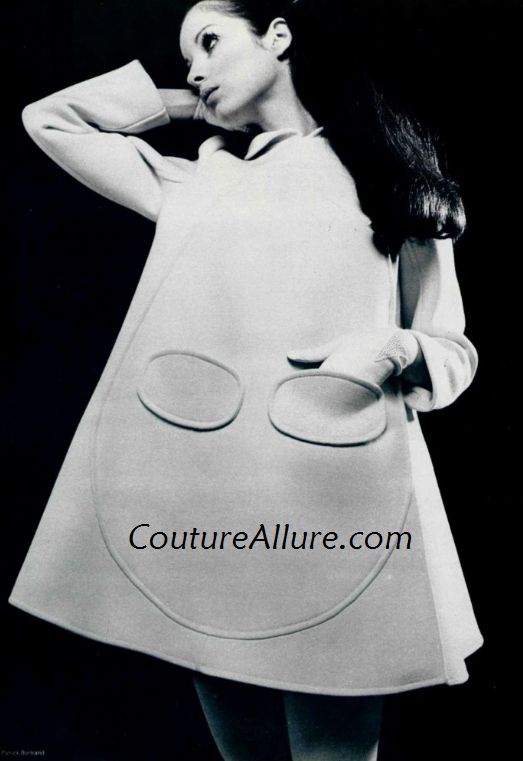
 Pierre Cardin, 1966
 Many vintage dresses were made with the understanding that the new owner would have the garment altered for a custom fit. As such, they are often made with sufficient seam allowances to let a dress out at the waist by 1"-2" or more. You can also consider letting out the back darts in the bodice to gain more room, although this sometimes leaves visible needle marks in the fabric. A talented seamstress can add narrow panels into the side seams to let out the waist even more. While an alteration like this is not invisible, it is a workable option if you need to let out a dress more than 3". Before buying, ask the seller how deep the seam allowances are or if there is sufficient fabric in the hem to cut narrow bands for those extra panels.




 Posts