Tuesday, March 08, 2011

Jean-Marie Armand

1969

Jean-Marie Armand was born about 1930. He got his start at Nina Ricci in 1953 and continued there for 7 years, working his way up to an assistant designer position.

Madelaine de Rauch, Spring 1961

Armand's first big break came in 1960, when he was hired as the designer for Madelaine de Rauch. His first solo collection for de Rauch was shown in January 1961. For weeks before the line was presented, rumors abounded that Armand was the next great talent. However, the line was a huge flop, as he showed nothing new or innovative. In fact, Armand showed tailored suits, coats, and dresses that were too similar to the designs he used to produce at Nina Ricci. The audience was so disappointed, many people walked out before the show was complete.

1969

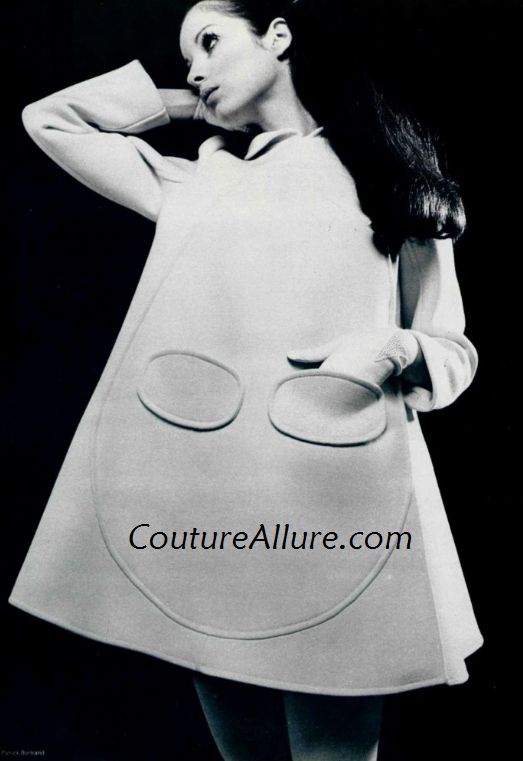
Armand then disappeared from press mention until July of 1965 when he opened his own small couture house in Paris. His designs were very modern and architectural, much like those of Courreges and Cardin. He introduced his quadrangular skirt, one made of 4 panels whose seams formed an angular shape (see first photo above). He continued to use the quadrangular design season after season.

1969

His star continued to rise for the next few years as his unusual designs met with acclaim. His tiny Paris showroom was known for it's Mod look with white walls, spherical seats, and plexiglass runway.

1968

Armand reached the height of his career in 1968 and 1969. You see many of his best designs from those years here. An interesting note about Armand's designs: He never used buttons as he thought they ruined the lines of the garment. His coats always closed with hidden snaps.

Mentions of Jean-Marie Armand disappear from the press in 1971. Perhaps he was unable to adapt to the softer and less structured aesthetic of the 1970s. Perhaps he closed his showroom for good and retired. I am unable to find a reason for his disappearance. If anyone has more information, please contact me or comment here.

UPDATE: Facebook fan Nadine has graciously allowed me to share this photo of a Jean-Marie Armand coat that is in her personal collection. Thank you, Nadine!


Please note: This biography about Jean-Marie Armand is copyright of Couture Allure and may not be copied without permission.

Monday, March 07, 2011

Fun Stuff and Nonsense - 1958

Flipping through a 1958 magazine today, various things caught my eye. Rather than search for a theme to build them around, here is some random fun and nonsense.

Delightful fun! Oh, how I want this hat! John Frederics blue and white striped sailcloth with a blue plastic window to peek through. Sold for $7 in 1958 (about $53 in today's dollar.)

Sultry fun. The model in this image exudes sensuality with her tousled hair and come-hither glance. She wears a white silk shirt by Emilio Pucci. Sold for $35 in 1958 (about $267 in today's dollar.) Does anyone know who this model is?

Luxurious fun. I've never seen a mink jacket with such a brief cut, but I love it! By Bergdorf Goodman's custom furrier, Emeric Partos in white mutation mink. Sold for $2,420 in 1958 (about $18,441 in today's dollar.)

Outrageous fun! These ankle boots by Capezio were made of wool blanket plaid and black patent leather. Fringe falls over the top edge. Sold for $17 in 1958 (about $130 in today's dollar.)

And some nonsense. Harriet Hubbard Ayer offered Midas Touch spray on color to add streaks of shimmering silver or gold to your hair. It may have been fun for the younger set, but the the ad suggests it is great for gray hair! I think it just looks silly......unless it's Halloween.

Sunday, March 06, 2011

New at Couture Allure - Vintage 50s Dresses and Jewelry

This week at Couture Allure we've added several 1950s full skirted dresses for spring and some fabulous vintage jewelry. Be sure to check our What's New pages to see all the latest listings!


Saturday, March 05, 2011

Weekend Eye Candy - Charmis Swimsuit, 1953

I posted this photo on the Couture Allure Facebook Fan page this past week and it got such a positive reaction, I wanted to share it with those of you who may not have seen it. This has got to be one of the sexiest swimsuits I have ever seen. French, of course. Probably heavily boned or wired at the top. And it probably came with removable straps. Black wool and Lastex maillot by Charmis.

Friday, March 04, 2011

My Fascination Continues

Last week, I showed you some images of quirky fashion from 1984 that intrigued me. Today, my fascination continues with a look at garments from 1983. I'm starting to see a common theme: unusual shapes, combinations of subtle patterns and textures, and neutral colors. Where will this take me? And where can I find clothes like this today? My search begins.

Jean-Charles de Castelbajac

Jean-Charles de Castelbajac

Issey Miyake

Jean-Charles de Castelbajac

Dorothee Bis

Wednesday, March 02, 2011

Livia Firth's Oscar Gown - a "Green" Triumph or a Vintage Tragedy?

Livia Firth, co-founder of Eco Age, a retailer of green and sustainable products, issued her "Green Carpet Challenge" a couple of years ago in which she pledged to only wear eco-friendly, sustainable, and green fashion on the red carpet as she accompanied her husband Colin during awards season. I applaud Livia's goal, and many of the dresses she has worn in the past meet the challenge admirably.

At the 2011 Golden Globes, Livia wore a gown made of sustainable Ahimsa silk (peace silk) designed by Jeff Garner of Prophetik.

At the 2010 Oscars, Livia wore a gown by Orsela de Castro of From Somewhere, who uses the scraps from other clothing factories to make her creations.

For this year's Oscars, Livia hired designer Gary Harvey to make her gown. Mr. Harvey has become well known for his designs using up-cycled used clothing. According to Livia's blog at Vogue.uk, Harvey "scoured Southeast London for the right pieces, from Cancer Research shops to vintage boutiques, such as 360 Degrees Vintage." The goal was to use clothing from the 30s to honor the era in which the film "The King's Speech" was set. Colin Firth was nominated for an Oscar for his role in that film.

Pursuant to that goal, Harvey cut up 11 vintage evening gowns from the 1930s and patchworked them into the 1 dress worn by Livia for the 2011 Oscars. But can we truly consider this "green" or "sustainable"?

Many vintage fashion lovers, myself included, wondered about the condition of those 11 gowns from the 1930s. Lynn Burgess, the owner of 360 Degrees Vintage, declared on her Facebook fan page that, "He bought the very best gowns". We can possibly presume that since she owns a well known and highly respected vintage clothing store in London, the dresses must have been in at least wearable condition. She later stated, "I did say he bought the best gowns. I didn't say they were perfect most vintage garments will have some sign of wear and tear." Yesterday, on the Ecorazzi blog, she stated, "“Although the dresses Gary picked were beautiful they were far from perfect. There was some damage to the netting and the top part of the dress which he removed. The other dresses had some signs of wear and staining which he managed to cut out and reconstruct to make Livia’s stunning dress.”

To be fair to all parties involved, I contacted Gary Harvey and Livia Firth with this question: "Were the gowns that you used in wearable condition as they were or would they have been considered damaged beyond repair?"

Mr Harvey responded to me this morning with this statement (italics by me): "This is an unjust criticism, I am a designer with a conscious rather than destroying collectable clothing, I am preserving it for future generations.

Firstly, I have the utmost respect for vintage clothing, an avid collector for the last 20 years, I have scoured the vintage stores and markets across Europe, The USA and Japan, and as Creative Director for Levi’s I was responsible for the design of the ‘LEVIS Vintage Clothing’ lines (authentic reproductions of LEVIS Jeans wear since 1873) and a regular visitor to the LS&Co archives in San Francisco.....

The 11 dresses used in Livia Firths Oscars dress were sourced from the millions of dresses available in the second hand market-place, there is literally tons and tons of vintage clothing out there just waiting for a new lease of life.

My aim with the design was to show Livia Firth looking amazing in the most beautiful dress supporting her husband as he collected his Oscar, I also wanted people to realise that just because something has been pre-owned, is not current, too small, ripped or stained there is still potential for reuse, thus raising the profile of vintage clothing and up-cycling.

Yes the dresses and fabrics were all sourced from or inspired by the era of the Oscar winning film ‘The Kings Speech’ however not one of these garments was suitable to wear in its current state, due to distress, damage or decay, they had all been beautiful dresses once, this is the true nature of recycling, I have preserved and given new life to these vintage garments, some of which would have ended up in land-fill."

Livia Firth has not responded to me as yet. Many people from the vintage community, myself included, commented on Livia Firth's blog questioning her choices in this matter. All those comments have been removed from the Vogue.uk site and new comments are now being blocked.

The question remains, were the 1930s dresses used for Firth's Oscar gown in wearable condition or not? If they were, then a tragedy has been visited upon valuable vintage clothing. If not, then Harvey's standard of "reuse, reduce, and recycle" can perhaps be utilized as an example of how to keep damaged clothing out of our landfills. I'll let you draw your own conclusions.

What say you? Triumph or tragedy?

UPDATE: Livia Firth and Lucy Siegle have responded to this controversy via Huffington Post. I find their tone to be very dismissive, and the idea that gowns were cut up because they were "too small" for anyone to wear is simply outrageous.

Meet Laura Again!

You've met Laura before. One of my favorite customers, Laura has a wonderful sense of style and knows what will work for her. She recently purchased this dress from Couture Allure.

Doesn't she look great? Laura wore this dress recently on the night when her boyfriend proposed and they are to be married in October! Congratulations, Laura! We are now on the hunt for the perfect vintage wedding dress.

Tuesday, March 01, 2011

Why Can't I Find a 50s Dress That Will Fit Me?

James Galanos, 1955

That's the#1 question I get in my inbox. Other versions are, "Why are the waist sizes on all your 50s dresses so tiny?" or "My measurements are 36-30-37 (or 42-37-44, or 39-33-38). Do you have a 50s dress that will fit me?" In fact, I get this question so often, I am going to address it here for all of you who have been frustrated in your search for an authentic vintage dress.

The fact of the matter is, the industry standard for measurements in the 1950s was a 10" difference between the bust and waist. That means if you find a dress with a 36" bust measurement, 9 times out of 10, that dress will have a waist that measures 26". If you don't have a waist that is 10" smaller than your bust (and believe me, most of us modern women don't), that explains why you're having a difficult time in your search.

So what's a gal to do? Here are some suggestions to help you overcome the obstacles.

#1 - Consider foundation garments.

Yes, a girdle. In the 1950s, every woman wore one nearly every day starting in her teens. If you'd been wearing a girdle from the age of 15 or so, you'd likely have a tiny waist too, as it would have been trained into shape! I've talked about the importance of wearing foundation garments with your vintage dresses before. If your waist is only 1"-2" larger than what it needs to be to fit into that dress, wearing a strong girdle or waist cincher may be just what you need to get that dress to fit. I'm not talking about Spanx or shapewear. They just won't give enough support. Here are some suggestions for finding the correct modern foundation garment for you.

#2 - Consider separates.

If you can't find a dress that will work, consider separates. Look for a vintage skirt that will fit your waist and pair it with a blouse, a knit top, or a jacket that fits your bust. Voila!

#3 - Consider a dress from the 60s instead.

Pierre Cardin, 1966

By the mid-to-late 60s, women were moving away from wearing a girdle at all times, and styles moved to a more relaxed waistline. If there is a 6" or less difference between your bust and waist measurements, your body type may be more suited to a shift or empire waisted style from the 1960s. Try it!

#4 - Have a dress altered to fit you.

Many vintage dresses were made with the understanding that the new owner would have the garment altered for a custom fit. As such, they are often made with sufficient seam allowances to let a dress out at the waist by 1"-2" or more. You can also consider letting out the back darts in the bodice to gain more room, although this sometimes leaves visible needle marks in the fabric. A talented seamstress can add narrow panels into the side seams to let out the waist even more. While an alteration like this is not invisible, it is a workable option if you need to let out a dress more than 3". Before buying, ask the seller how deep the seam allowances are or if there is sufficient fabric in the hem to cut narrow bands for those extra panels.

#5 - Sew your own or have a dress custom made.


Most of the major pattern companies now offer modern reissues of vintage styles. And vintage patterns abound on the web. If you can sew and know how to alter a pattern to fit, making your own dress is a great option. If you are going to use a vintage pattern, you'll likely have to know how to grade the pattern up or down to fit your size. If you can't sew, find a good custom dressmaker in your area to do the job for you.

I hope these suggestions help you in your search! If you have another to add, please post it in the comments!

Monday, February 28, 2011

The Little Brown Dress

Christian Dior, 1949Christian Dior New York ribbed silk dress with a large bow draped across the bodice.

It is said that every woman should have a little black dress in her wardrobe. But if you subscribe to the "seasonal" skin tone theory, the only people who can truly wear black near their face well are those described as "winter". The rest of us should choose something less harsh like gray, navy, or brown. Granted, I wear black a lot, but rarely on top because I am a "spring". Black near my face tends to accentuate the rings under my eyes and makes me look tired. I do like to wear brown, though. It just works for me. What about you? Do you wear brown as a neutral in your wardrobe?

In the spring of 1949, brown was a popular color of choice for many fashion designers (especially M. Dior), as evidenced in these photos.

Omar Kaim, 1949Omar Kaim for Ben Reig silk organza and satin evening gown with a large bow at the side.

Christian Dior, 1949, suitChristian Dior Couture brown wool suit.

Jo Copeland, 1949Jo Copeland brown tulle over taffeta dress with low decollete.

Christian Dior, 1949Christian Dior Couture silk dress with fly-away skirt panel at the back.

Sunday, February 27, 2011

New at Couture Allure - Vintage 60s Mod Dresses and More!

New this week at Couture Allure are some fabulous graphic print dresses from the 60s and more 50s dresses. Be sure to check our What's New page to see all the new items!


Saturday, February 26, 2011

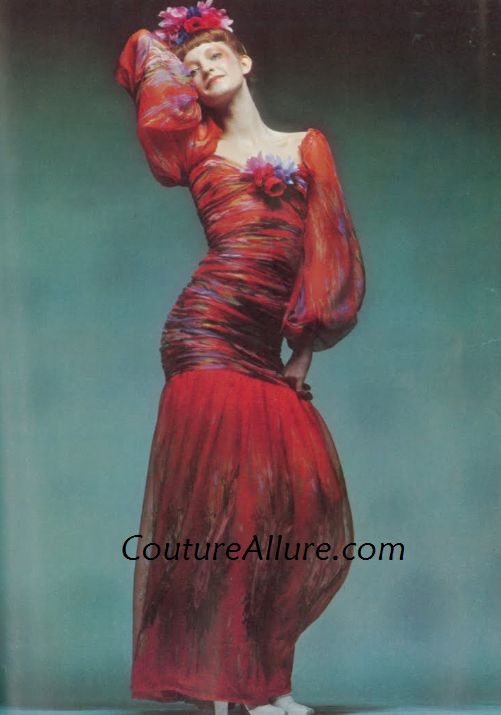
Weekend Eye Candy - Nina Ricci, 1970

Nina Ricci uses layer upon layer of printed silk chiffon for this dramatic look from Spring, 1970.

Friday, February 25, 2011

Pattern, Color, and Texture - 1971

It seems that every few years designers go a bit wild with pattern and color combinations. There was no wilder time than the early 70s when those crazy hippies were influencing high fashion as never before. Need proof? Look no further than these designer clothes from 1971.

Two half circles fashion a skirt and shawl by Chloe.
The diving girl adds a whimsical touch.

Yves St. Laurent tie dyed silk organza evening gown.

Missoni ensemble. The silk jersey skirt is printed with an
embroidered pattern from a 1920s piano shawl.

Oscar de la Renta beach caftan.

Thea Porter Ikat print silk chiffon blouse and long vest worn with panne velvet knickers.