Showing posts with label 1951. Show all posts

Friday, March 21, 2014

Welcome Spring!

Christian Dior, 1951
Now that Spring has officially sprung, I thought you might enjoy these takes on combining Mother Nature's floral bounty with fashion.
Maggy Rouff, 1951

1950, cartwheel hat in the form of a daisy.

Saturday, August 31, 2013

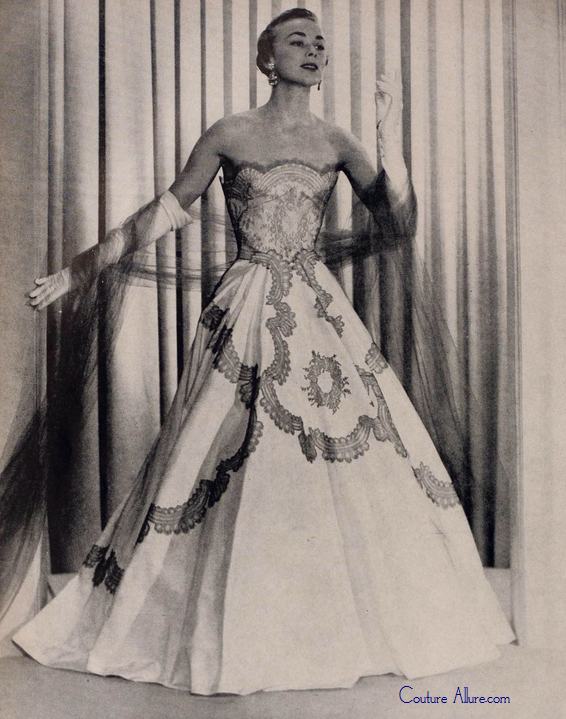
Weekend Eye Candy - Irene Evening Gown, 1951

This stunning evening gown was designed by Irene Lentz for the fall of 1951.  Blue lace stands out on white silk taffeta.  The lace appliques on the skirt are painstakingly and individually cut out and sewn on by hand. 

Saturday, July 27, 2013

Weekend Eye Candy - Jean Desses, 1951

Fall, 1951.  Jean Desses covers the sleeve of this black wool suit with a smocked black taffeta muff.  A matching hat completes the ensemble.  Love, love!

Thursday, July 25, 2013

Paquin Suit - 1951

An astounding suit by the House of Paquin, 1951.  Lou Claverie was the designer for Paquin at this time.  The typical menswear fabric is made ultra-feminine with that pocket/peplum combination.  Love, love!

Tuesday, June 18, 2013

Gilbert Adrian Dresses, 1951

I thought you might like a peek at two of the Gilbert Adrian dresses I posted on my Facebook page yesterday.  These are both from 1951, and aren't they stunning?

Silk stripes with a fabulous attached drape that can be worn as a hood.

You can't easily tell, but this silk is printed with large white birds on a harlequin check.  The wide sleeves mimic bird's wings and there is a small white bird sitting above the bust on the left side as you look at the picture.

Thursday, May 30, 2013

Crinoline Petticoats, 1951

In August of 1951, Life magazine did a small article about the latest crinoline petticoats a woman needed to wear under the new full skirted fashions.  The magazine featured fashions by Anne Fogarty and showed the crinolines she used for her fashion shows to give the latest bell shaped skirts the oomph they needed.  I thought you might like to see those crinolines.

A quilted cotton dress worn over a black turtleneck sweater and with strappy sandals.

That heavy quilted fabric required a ruffled cotton petticoat or two.  Over the petticoat, the model wears a very stiff lacquered net slip with a wide horsehair braid hem.  The lacquered net crinoline provides the support needed for the heavy quilted fabric of the dress.

3 lighter weight dresses by Fogarty are shown with layers of petticoats underneath.

Prepping for a fashion show, the models don multiple ruffled cotton petticoats to wear under full skirted dresses.  In the foreground, you can see how stiff those lacquered net slips are.  They stand up on their own!

All photos by Nina Leen for Life Magazine, August 13, 1951.

Tuesday, April 30, 2013

The Details Make the Dress, 1951

One of the things I love about vintage dresses is the amount of work that goes into the details.  Case in point, this little black dress by David Marcus from 1951.  A lot of effort went into getting that collar just right so it frames the face and neck in such a beguiling manner.  The sleeve is not just a straight thing that hangs there.  It is cut with a slight bell shape and gathered into a cuff at the elbow.  The details are interesting enough that just a simple pair of earrings are all you need.

Photo by Clifford Coffin for Vogue.

Saturday, April 13, 2013

Weekend Eye Candy - Christian Dior, 1951

I adore the way Dior balanced the fuller than full skirt with the elegant drapery at the neckline.  Dior Haute Couture, Fall 1951.

Monday, August 20, 2012

Lanvin-Castillo - 1951

Blouse and skirt by Lanvin-Castillo, 1951.
I often marvel at the genius of couture.  What goes on in the minds of designers who dream up over-the-top fashion?  It's the fall of 1950.  Antonio Canovas del Castillo has been hired as the designer at Lanvin and needs to make a splash for his first collection in the Spring of 1951.  Was he sitting around one night, nervous as can be, folding and re-folding a piece of paper?  Was he unrolling a bolt of silk organza and the way the fabric folded upon itself caught his eye?  Did he take a class in origami at night school?  Whatever it was, Castillo's genius appeared in giant folds of white silk in several garments at that first showing for Lanvin.  And, oh, it was marvelous.

Same blouse, different view. Lanvin-Castillo, 1951

Another blouse, this one with giant folds at the collar.  Lanvin-Castillo, 1951.

And the piece-de-resistance, an incredible evening gown.  Lanvin-Castillo, 1951.


Saturday, July 07, 2012

Weekend Eye Candy - Jacques Fath, 1951

Petals fall diagonally around the skirt in this summer afternoon dress by Jacques Fath from 1951.  The dress is made of silk organza in white with black polka dots.  When I dream of wearing a dress from the 50s, this is my vision.  It's simply perfect in every way.

Saturday, May 12, 2012

Weekend Eye Candy - Dior Insect Dress, 1951

1951 - Christian Dior designed this white pique dress embroidered with insects.  Dragonflies, bumblebees, beetles, and more become inspiration for haute couture.  You've got to love that!

Friday, January 20, 2012

Larry Aldrich Dress - 1951

Larry Aldrich jumps into the New Look in 1951 with this dress made of black rayon faille.  The full skirt is pleated onto a dropped waist and measures 4 yards around at the hem.  Sold for $50 in 1951 (about $435 in today's dollar.)

Friday, December 09, 2011

Friday Fur - Revillon, 1951

Winter, 1951.  Revillon Furs takes a simple black wool swing coat and ups the ante with a fitch fur lining edged in jaguar.  Jaguar also forms the cuffs on the sleeves.  Interesting mix of two furs, isn't it?

Saturday, November 19, 2011

Weekend Eye Candy - Balenciaga, 1951

Yet another simply gorgeous gown for your holiday dreams.  This strapless black velvet gown has a mermaid hem filled with layers of white tulle.  I've always had a soft spot for this style of dress because I had the Solo in the Spotlight dress for my first Barbie.


Wednesday, November 16, 2011

Style Statements - Animal Print and Vintage Muffs

1951
How do you take a simple gray wool suit into the stratosphere?  Add some animal print in your accessories!  Just the hint of print in the scarf she has tucked inside the jacket neckline makes the suit more interesting.  Add an animal print handbag and you've tied it all together.  I wonder what her shoes look like?  They could be animal print, but it's more likely they are gray or black.

Muffs like this one were popular from the 30s to the 50s.  They are a great way to keep your hands warm when the winter wind blows.  Most have hidden zipper pockets so you can carry your I.D., some money and your lipstick.  I'll bet you could even fit your cellphone in there.  And who needs more than that when you want to make a style statement?  We've got a couple of muffs available at Couture Allure right now.  Check them out!

Monday, November 14, 2011

What We Were Wearing - Fall 1951

Here is what women were wearing 60 years ago this month.

After being introduced 3 years previous by Dior, full skirted dresses and skirts are now becoming popular and worn for everyday wear by most women.  The skirts are more bell-shaped than the full circles that will become stylish in a few years.  Most are worn without crinolines for daytime.

Every woman had a basic suit in her closet to wear in town, for meetings with professionals, for shopping in the city, or for dinner at a fancy restaurant.

For more casual daytime wear, a skirt with a blouse, sweater or twin set was the way to go.  Pants were rarely worn by women, and if they were it was strictly for work around the house or farm.

Princess line and swing coats were the newest styles that came about to accommodate the fuller skirts, but many women also wore simple straight coats.

Most women had or wanted a fur jacket or stole in their closets.  For those who could not afford expensive options like mink or fox, there were many made from less costly furs like marmot, mouton and rabbit.

Full skirted styles were popular for evening and cocktail wear.

Evening gowns were elaborate with draped skirts and trains with rich satins being most popular.

No matter who you were, you rarely left the house bare headed.  Hats were a fashion necessity.

Saturday, September 10, 2011

Weekend Eye Candy - Jean Desses, 1951

I have a thing for full skirted princess coats from the late 1940s and early 50s.  This one by Jean Desses from 1951 makes me swoon with joy.  It's plaid!  Blue, green and brown plaid to be precise.  And look at the button detail on the pockets and sleeves! J'adore!

Tuesday, May 17, 2011

New Ways to Wear a Scarf - 1951

One of the most versatile and dramatic accessories in your wardrobe is a pretty scarf.  Scarves add a pop of color to any outfit.  Fill your closet with high quality basics and dress them up in a myriad of ways with a collection of scarves.  Here are some different and fun ways to wear a scarf from 1951.  Need more?  Blogger Une Femme has put together some fabulous videos showing various techniques for tying scarves.  I find myself referring to these over and over.

Loop an 18" square over your belt and hold it in place with a vintage brooch.

Twist that same small square scarf through a string of pearls and knot at the side.

For a 36" square scarf, pull it through your belt and tuck a corner into the neckline of your dress.  Let the rest of the square hang loose in an apron effect.  This works best with a fabric that has stiffness or body, like taffeta.

For a blouse effect under a suit jacket, take a 36" square scarf, fold it in half diagonally and wrap around your neck with the point to the back of your neck.  Tuck the ends into your belt or skirt waistband.

Take a dress with simple lines and jazz it up with a long rectangular stole draped over your neck and belted.  This works best with a light and floaty scarf.

Use a large rectangular scarf in a bold pattern as a stole with a simple cocktail dress.

Or tie that same stole around your waist looping the ends over each other for a dramatic accent to your skirt.

Did you know that we offer a wonderful selection of vintage and designer scarves at Couture Allure?  Check them out!

Thursday, May 12, 2011

What's in a Size? 1950s Petites and Half Sizes

Sizing standards have changed so much over the years, it's hard to know what size one wears any more.  Add to that the fact that in the 1950s, garment manufacturers made clothes in many more sizes than their counterparts today, and the choices can be dizzying.  This week we're looking at the various size ranges manufactured in the 1950s and what that means for you when you're shopping for a vintage dress.

Petite or Diminutive sizes are made for a woman is 5 feet 5 or under.  This woman will find that a misses size fits at the shoulders, waistline and hips, but is much too long-waisted and long in length.   Petite sizes are even numbers, usually 10 - 18 and will be shorter in overall length and from shoulder to waist (usually 14" - 15").  Here are two examples from 1951.

 This Martha Manning Petites suit of beige sharkskin is sized proportionately for the shorter woman and looks great with the poodle cloth stole.

This woman is in her 40s, but her figure is sleek enough for this dress and jacket set by Hannah Troy in petite sizing.

Half sizes are for women who are high waisted (usually 15" - 16" shoulder to waist) but a bit wider and heavier than the petite woman.  Half sizes run from 10 1/2 to 24 1/2.  Here are two examples from 1951.

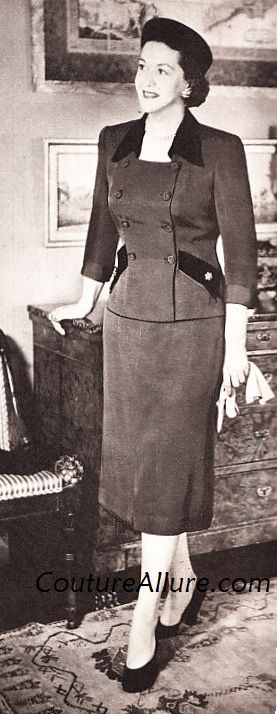
For the woman who is a bit heavier and shorter but still trim, this half size suit by Forever Young in rayon ottoman with velvet trim is a wonderful option.

For the fuller but shapely and shorter figure, a half size is the perfect choice.  This black dress by Young Viewpoint has an easy skirt and points at the neckline to give a look of length.

Wednesday, May 11, 2011

What's in a Size? 1950s Misses Sizes

Sizing standards have changed so much over the years, it's hard to know what size one wears any more.  Add to that the fact that in the 1950s, garment manufacturers made clothes in many more sizes than their counterparts today, and the choices can be dizzying.  This week we're looking at the various size ranges manufactured in the 1950s and what that means for you when you're shopping for a vintage dress.

If you're tall and slim, you probably wear a misses size.  Misses sizes are perfect for the slender woman with wide shoulders, a long waist (at least 16" shoulder to waist) and long legs.  The size numbers are even and in the 1950s started at 8 and ran up to a 20.  The clothes shown here are all from 1951.  All four women are different ages, but all wore a size 12.

 Every woman should have a black crepe dress in her wardrobe.  This one by Herbert Sondheim has that touch of sophistication with it's soft skirt and flashes of yellow at the throat and cuffs.

This young looking grandmother wears a gray wool suit by Anna Miller.  The stiffened swirled peplum is a feature that she has the height to wear successfully.

If you're a young woman who likes to experiment, try a coat and dress ensemble instead of a suit.  This one by Pat Warren for Nantucket Naturals is in three tones of yarn dyed gray wool jersey.

A teenager tall enough to wear a misses' size will find that most vintage dresses that fit look too mature.  Try separates instead!  A plaid cotton shirt and pleated gray flannel skirt by Toni Owen are simple and smart.